Sunday, May 19, 2013

How to Speak with an Atheist Friend or Loved One

Atheists: Dawkins, Harris, Hitchens

In this post, I'm going to share with you what I believe to be the most powerful way to speak with atheists. But first...

Last night I had the sad experience of learning that one of my cousins is an atheist. I say sad, because all my hope in this life comes from my faith in Christ. If I did not have Christ, I don't know what would happen to me.

I am not saying that atheists cannot be naturally happy or even naturally virtuous. However, I am a man of faith. I am a Catholic. I believe in Heaven and Hell. I want everyone I meet to go to Heaven...not Hell. With eternity on the line, we need to be intentional about what matters most. So how do we share our faith effectively?

I know many atheists. I have friends and family who are atheists. We speak openly about God, morals, and the afterlife. Regrettably, I used to be much more aggressive in my approach. I don't think aggression or argumentation (however logical) works.

So what does work?

Let me suggest that you first pray and second remain calm. Third, ask your atheist friend this question: "Do you believe in love?"

In other words, is love real? Spend your time discussing love. Is love an instinct? Is it a passion? Is love a hormonal phenomenon? Is love a virtue? Is love a "force"? Is love a "thing"? Where does love come from?

Love is a great way to begin. Very few people will reject the existence of love. That's a great thing! You have somewhere to start.

As much as I love Thomas Aquinas, I realize that the atheist remains unmoved by the five ways of Thomas. (By the way, I discuss this phenomenon regarding atheism and Aquinas in my new free ebook which you can get on May 31 if you sign up for it.) Most atheists don't disbelieve because philosophical arguments from causality. Most atheists disbelieve because they have experienced sheer evil in the world.

So don't start with causality or evil! Start with the idea of love and begin the great conversation. I think you'll discover a strong way forward if you apply this approach with grace, love, prayer, and personal penance.

Remember. You can only rightfully share God (who is Love) if you speak and act with love. If you come off as angry or judgmental, forget it.

Question: Do you have friends or loved ones who are atheists? Would you share some tips with us? Do you have success stories? Please share!

Do you enjoy reading these posts by Dr. Taylor Marshall? Make it easier to receive  his new daily posts. 

Receive these blog posts through email free by clicking here.

Privacy Guarantee: Your e-mail will never be shared with anyone. 

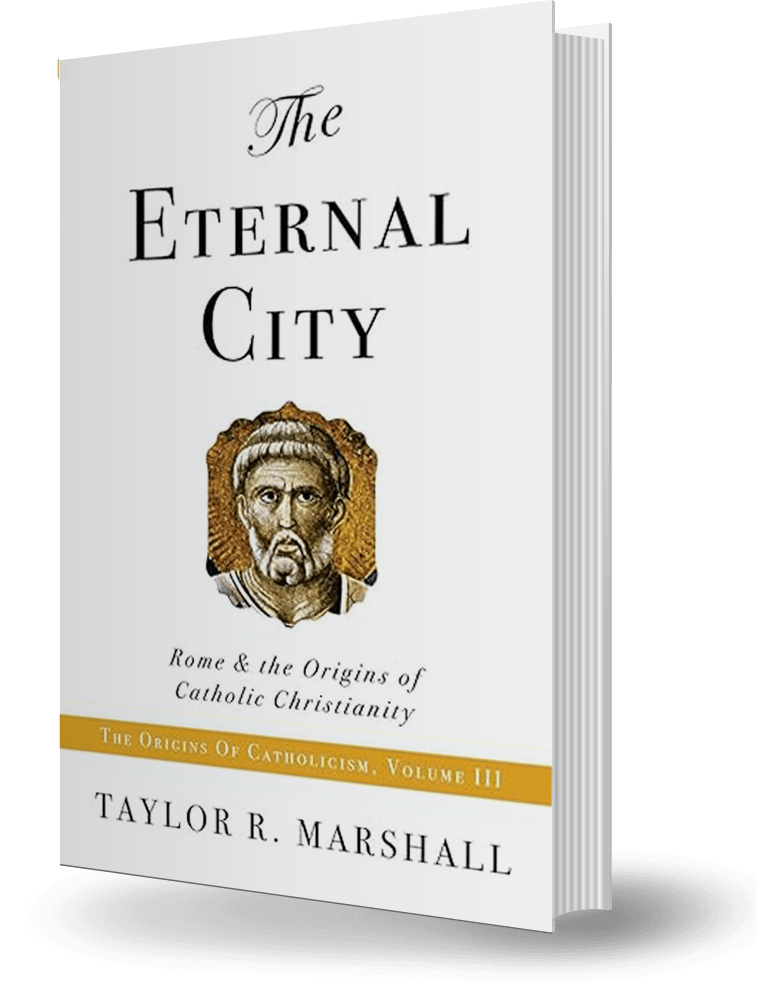
Also, please check out my brand new book The Eternal City: Rome & the Origins of Catholicism at amazon.com by clicking here.

Friday, May 17, 2013

Pope Francis Calls for Natural Law & Ethics


Our Holy Father Pope Francis recently spoke about the new idol or 'golden calf' of the First World: the quest for money and power (May 16, 2013). The Holy Father proposed that this dire situation requires a return to ethics.

There is one phrase in the Holy Father's speech that I haven't yet seen noted as significant. It is the Holy Father's phrase "natural ethics." The Holy Father speaks of a true "natural ethics" as opposed to a false "ideological ethics."

I wrote my PhD dissertation on Thomas Aquinas' doctrine of natural law and when I read things like this, my Thomist alert system starts going off. I am exhilarated to read this. Personally, I find it refreshing to see Pope Francis as willing to attack materialism and false economies through the lens of natural law and ethics.

If you read the speech, you begin to discern that natural law is between the lines. This signals that Pope Francis will be continuing Pope Benedict's insistence on the authentic natural law tradition of Thomas Aquinas and the Catholic Tradition.

In September of 2011, Pope Benedict addressed the German Bundestag (Parliament) and insisted on a return to natural law as a possible way forward for Germany and Europe. Benedict was greatly mocked and derided for his "archaic ideas," as you may remember. Nevertheless, Benedict was bold and heroic.

It now appears that Pope Francis is willing to continue that same fight against secularism with the same tools.

Personally, I believe the American obsession with "the right of religious freedom" is battle which we will lose. We have a much better footing if we follow Benedict and Francis' lead with a return to the authentic natural law tradition. This is a rich and hallowed tradition and the Church...and it is powerful. For me the battle over a "right to religious freedom" sounds more like Thomas Jefferson and less like Thomas Aquinas.

Bravo to Pope Francis. I will be reading Pope Francis' speeches and I'll keep you posted. If any of you note something related to natural law in Pope Francis' discourses, please let me know via Twitter or Facebook. I look forward to being in touch with all of you. Thank you for reading!

Godspeed,

Taylor

Question: Do you think the Catholic Church can make progress with the "religious liberty" argument? Why or why not? What about a return to natural law? Why or why not? Please leave a comment below.


Do you enjoy reading these posts by Dr. Taylor Marshall? Make it easier to receive  his new daily posts. It's FREE.

Receive these blog posts through email by clicking here.

Privacy Guarantee: Your e-mail will never be shared with anyone. 

Also, please check out my brand new book The Eternal City: Rome & the Origins of Catholicism at amazon.com by clicking here.

Thursday, May 16, 2013

Best Photo of Pope Francis Yet!!!


This morning I saw this photo of Pope Francis on Yahoo News and it blew me away. This is by far my favorite photo of Pope Francis yet.

His face says it all!

Do you like it? Please leave a comment.

Do you enjoy reading these posts by Dr. Taylor Marshall? Make it easier to receive  his new daily posts. It's FREE.

Receive these informative blog posts through email by clicking here.

Privacy Guarantee: Your e-mail will never be shared with anyone. 

Also, please check out my brand new book The Eternal City: Rome & the Origins of Catholicism at amazon.com by clicking here.

Wednesday, May 15, 2013

4 Encouraging Ideas from a 12 Year Old Saint


Saint Dominic Savio (1842-1857) was a young man under the spiritual care of Saint John Bosco. He began to study for the priesthood until he became ill and died at the age of 14.

When he was still only 12 years old, Dominic set down four rules by which he would live and become a saint. 

They are simple and beautiful:

1. I will go to Confession and to Communion often.
2. I will keep holy the feasts days.
3. Jesus will be my best friend.
4. And I would rather die than to commit a sin.

How is that for a list of resolutions? Only a child would love so simply. 

If we could keep these four resolutions in our hearts with love, each of us would become a great saint. 

By the way, this would be a great little list to give young people at the First Communion and Confirmation. This should be printed up on holy cards. I'd buy 100 of them!

Please print these four resolution and put in on your mirror to remind you every morning the simple and small way to sainthood.

Also, please forward this on to your friends for their edification.

Question: Are you skeptical? Can becoming a saint be this simple? Please leave a comment below and share your thoughts. 

Do you enjoy reading these posts by Dr. Taylor Marshall? Make it easier to receive  his new daily posts. It's FREE.

Receive these blog posts via email by clicking here.

Privacy Guarantee: Your e-mail will never be shared with anyone. 

Also, please check out my brand new book The Eternal City: Rome & the Origins of Catholicism at amazon.com by clicking here.

Tuesday, May 14, 2013

Recommended Book on Pope Francis: Dr. Moynihan's 'Pray for Me'


A week ago, Image Books sent me a review copy of Dr. Robert Moynihan's new book on Pope Francis: Pray for Me: The Life and Spiritual Vision of Pope Francis, First Pope from the Americas.

Those of you that have read my blog for a few years know that I cite Bob Moynihan frequently. I am convinced that he has the most brilliant and accurate insights about Pope Benedict. I trust his reading on the pulse of the Vatican. His wonderful blog can be found at: themoynihanletters.com.

I was with Robert Moynihan at a cocktail party last night and I shared with him how I was amazed to discover his new book was 256 pages. "How did you churn out a Pope Francis book in a matter of days? Pope Francis had been Pope for less than 2 months!" It turns out that he had a contract to write a book on the "next Pope" before the conclave even began. Even still, he did not know who the next Pope would be. It's a testimony to his "Vatican Insider-ness" that he was able to produce a sizable book on the new Pope in so short of a time.

[In our discussion, Dr. Robert Moynihan said that he's a reader of my blog and that he likes it - that pretty much made my night!]

From the moment Bob Moynihan announced Cardinal Bergoglio as the "Cardinal who rides the bus" on Fox News, he began to work on this book. Now we have it.

If you want a one stop resource on Pope Francis, this is the book to get. Buy it and read it. 

If you want to double up on all things Roman, pair Moynihan's newest book with my newest book: The Eternal City: Rome & the Origins of Catholicism and get free shipping:


Do you enjoy reading these posts by Dr. Taylor Marshall? Make it easier to receive  his new daily posts. It's FREE.

Receive my blog posts via email by clicking here.

Monday, May 13, 2013

Photos of My Children at Confirmation on Saturday

The Marshall family celebrated a very special weekend. Our three oldest children received the sacrament of Confirmation. Bishop Seitz in Dallas was recently appointed Bishop of El Paso by Pope Francis. Due to the news, Father Longua, our pastor at Mater Dei, did the honor of conferring the sacrament.

Here is Gabriel William who took the name 'Sebastian'
with his Sponsor Jordan Low and Father Longua
after the ceremony.

And here are my twins Mary Claire (confirmation name Philomena) 
and Rose (confirmation name Veronica)
with their Sponsors Amanda Halisky and Deserae Low

Soldiers of Christ!

Please say a Hail Mary for each of them that they continue to bear the standard of our Lord Jesus Christ.

Do you enjoy reading these posts by Dr. Taylor Marshall? Make it easier to receive  his new daily posts. It's FREE.

Receive these  blog post through email by clicking here.

Privacy Guarantee: Your e-mail will never be shared with anyone. 

Also, please check out my brand new book The Eternal City: Rome & the Origins of Catholicism at amazon.com by clicking here.

Thomas Aquinas on the Special Crown of the Martyrs


At the Holy Sacrifice of the Mass this past Sunday, Pope Francis canonized 813 Martyrs from the Italian city of Otranto who were beheaded for refusing to become Mohammedans.

“As we venerate the martyrs of Otranto," proclaimed Pope Francis," let us ask God to sustain those many Christians who, in these times and in many parts of the world, right now, still suffer violence, and give them the courage and fidelity to respond to evil with good.”

These martyrs of Otranto are our brothers and sisters in Christ. They still love us. They still care for us. Their share in Christ is much more profound than we now experience.

Saint Thomas Aquinas teaches that the martyrs in Heaven receive a special crown or "aureole" when gives them a share in the reign of God. 

The aureole is a special halo that only martyrs, consecrated virgins, and ecclesiastical doctors receive in reward for striving against evil. Saint Thomas holds that the aureole is a divine endowment of regal power so that these saints have a special share in the divine power. This idea goes back to the Old Testament, the Apocalypse of Saint John, Saint Augustine, and Saint Bede.

Saint Augustine wrote: "No one, methinks, would dare prefer virginity to martyrdom" (De Sancta Virgin. xlvi). Consequently, says Saint Thomas, an aureole is due to virginity, and also to martyrdom. Thomas also writes:
Further, the crown is due to one who has striven. But in martyrdom the strife presents a special difficulty. Therefore a special aureole is due thereto.
The martyrs then have a special share in the heavenly reign of God. They always have and they always will. 

This is a biblical teaching. We read in the Book of Revelation that to the martyrs of Christ are giving a special status in Heaven. They say to Christ: "Thou hast made us a royal race of priests, to serve God; we shall reign as kings over the earth" (Apocalypse 5:10). Moreover, it is given to the martyrs of Christ to dwell beneath the heavenly altar of God on high. They are closely associated with the eternal sacrifice of Christ.

This, by the way, is why the relics of martyrs were placed in Catholic altars in the early Church. Their sacrifice as martyrs was tangibly linked to the infinite sacrifice of Christ on the Eucharistic altar.

Let's open the comments: Might you be called to be a martyr? How does one train for this honor?

Saint Vincent Ferrar says that those who have not received the sacrament of confirmation will not persevere under the Antichrist. Perhaps, the theology of the sacrament of confirmation needs to be articulated more in terms of soldier/martyr. We often stress the idea of "soldier of Christ" in confirmation but do we emphasize that the greatest soldiers belong to the "army of martyrs," mentioned in the Te Deum? Perhaps the anointing with chrism on the head signifies the aureole that could be won through martyrdom in witness to the love of Jesus Christ...

Do you enjoy reading these posts by Dr. Taylor Marshall? Make it easier to receive  his new daily posts. It's FREE.

Receive my daily blog posts through email by clicking here.

Privacy Guarantee: Your e-mail will never be shared with anyone. 

Also, please check out my brand new book The Eternal City: Rome & the Origins of Catholicism at amazon.com by clicking here.

Sunday, May 12, 2013

Photo: Pope Francis Honors His Mother in Heaven


Pope Francis honors Our Lady of Lujan (a Marian devotion from his motherland of Argentina).

The statue of Our Lady of Luján was crafted in Brazil and sent to Argentina. A settler ordered the statue of Mary in 1630 in order to reinvigorate the Catholic faith in Santiago del Estero. 

The cart carrying the new statue stopped at the residence of Don Rosendo Oramas, located in the present town of Zelaya. However, when the caravan wanted to resume the journey, the oxen refused to move. 

Puzzled by this, the travelers removed the statue from the cart. The oxen started to move again. This was taken as a sign that the Virgin wished for the statue to remain at this location. The statue was revered there for several decadues until it was enshrined at Lujan.

Do you enjoy reading these posts by Dr. Taylor Marshall? Make it easier to receive  his new daily posts. It's FREE.

Please sign up to receive these informative emails by clicking here.

Privacy Guarantee: Your e-mail will never be shared with anyone. 

Also, please check out my brand new book The Eternal City: Rome & the Origins of Catholicism at amazon.com by clicking here.

Friday, May 10, 2013

Why Confess Sins to a Man? (Blanquette de Veau vs Burrito Supreme)


Why do we Catholics confess our sins to priests who are mere men?

This is a question that Protestants repeatedly raise. I raised it as a Protestant almost every time I spoke to a Catholic about matters of religion. Even Catholics are puzzled by it.

Even one of my sons asked me, "Dad, it's difficult. Why must we confess our sins to a priest when it is God that forgives us? Why not go straight to Jesus?"

This is a great question and it deserves more than a well-packaged apologist's answer. We all know the quick and easy answer:
  1. Jesus Christ gave the Apostles authority to forgive sins in John 20:21-23. 
  2. The Apostles are the first priests and they are mere humans. 
  3. Priests (with historical succession from the Apostles) can only declare the forgiveness of sins if they are told the sins by those who committed the sins.
  4. Therefore, we must reveal the sins to the priests so that these sins will then be forgiven through a means defined by Christ who is God.
That's tight. It's logical. It works.

But there's a harder question beneath all of this: 

"But why did Jesus set it up like this? Could not have Christ arranged things so that we merely voiced each and ever sin to Him? Why did Christ introduce an intermediary stage?"

Here we move away from easy apologetics. We move to the heart of it. Why must I reveal deep, dark, and embarrassing things to a man wearing a purple stole. Christ already knows. Why bring in a middle man? Laymen, monks, nuns, priests, bishops, cardinals, even Popes - everyone has to do it. Why?

I cannot presume to know the mind of God. However, I have an idea...

Christ knows that we would cheat ourselves. That's right. We wouldn't take the sin seriously. Nor would we take the grace received seriously. 

I have confessed my sins straight to God. I have confessed my sins to God in the presence of a priest who heard every word. There is a qualitative difference between the two ways. 

By myself, I am repentant about "my sins." It's general and less precise. However, when I confess my sins in the presence of the priest, it is specific. Moreover, there is a sense of dread followed by a wave of mercy crashing upon my soul.

I think the difference is like eating at Taco Bell vs eating at an elegant French restaurant. They both advertise food. But the French restaurant provides an experience. The French restaurant experience includes a gentleman wearing black and white. (Sound familiar?)

Regardless of the food, the experience is better and more connected at the French restaurant because it is mediated by a human server who has a real human experience with you.

The French waiter cares for you during the experience, carries and presents the entrees to us, elegantly clears the table, scrapes the bread crumbs off the linen with that little device, and then makes sure that we are comfortable and happy. The post-production of the desserts and digestifs are also a big part of the experience.

Nobody does that at Taco Bell and that's why it's Taco Bell.

My suggestion is that Christ instituted the sacrament of Penance because He passionately desires for us to experience His Divine Mercy in a tangible way. Forgiveness requires a human experience - not just words.

It would be more difficult for a woman to feel healing in her bedroom as she confesses an abortion from 25 years ago. However, in the presence of a fellow sinner (the priest), she hears words of comfort and then an audible and divinely ratified proclamation that her sins are officially forgiven and cast into the sea.

That's the difference between a Burrito Supreme at the drive through and enjoying Blanquette de Veau or Beef Bourguignon under the care of a French waiter with the help of his sommelier.

Of course, the Blanquette de Veau or Beef Bourguignon experience costs you a lot more than the quick Burrito Supreme in a wrapper: But which would you prefer?

Yes, confession to a priest has more "emotional cost"? But would you have it any other way?

Time to open the comments: Would you agree that Christ set up the forgiveness of sins in the best possible way? Is the "emotional cost" worth it? Please leave a comments about your own experience.

Also, please forward this on to 5 or 6 friends who may have problems with "confessing sins to a human." Even better, please share it on Facebook or Twitter

Do you enjoy reading these posts by Dr. Taylor Marshall? Make it easier to receive his new daily posts. It's FREE.

Receive these upbeat and informative emails by clicking here.

Privacy Guarantee: Your e-mail will never be shared with anyone. 

Also, please read my brand new book The Eternal City: Rome & the Origins of Catholicism at amazon.com by clicking here.

Thursday, May 09, 2013

Was Christ Assumed into Heaven?


Catholics sometimes make the claim that while Christ "ascended" into Heaven, our Blessed Mother was "assumed" into Heaven. The difference, they say, is that Christ ascended by His own divine power; but that Mary was raised by the power of God. The apologist using this argument usually seeks to show Protestant objectors that Mary's assumption is categorically different than Christ's ascension.

Such an argument is fundamentally correct and in accordance with orthodox theology, but the vocabulary isn't correct. As a result the argument can be a little confusing. 

The Language of Ascension and Assumption
The Greek and Latin used in the Gospels (and Acts) employ terminology of "assumption" for the ascension of Christ. First let us examine three verses that describe Our Lord's ascension in terms of assumption, and then describe the theological significance.

“Et Dominus quidem Jesus postquam locutus est eis, assumptus est in cælum (He was assumed into Heaven), et sedet a dextris Dei.” (Mark 16:19, VGCLEM)

“usque in diem qua præcipiens Apostolis per Spiritum Sanctum, quos elegit, assumptus est (He was assumed)” (Acts 1:2, VGCLEM)

“qui et dixerunt : Viri Galilæi, quid statis aspicientes in cælum ? Hic Jesus, qui assumptus est (Who was assumed) a vobis in cælum, sic veniet quemadmodum vidistis eum euntem in cælum.” (Acts 1:11, VGCLEM)

For our Greek scholars, the Greek word here in Mark and Acts is the aorist passive form of ἀναλαμβάνω. It corresponds to "taken up" or "assumed."

The conclusion is that Scripture uses the language of ascension and assumption for Our Lord's transition into Heaven. (Saint John's Gospel frequently uses the language of ascension.)

The Theology of Ascension and Assumption
The obvious difference between the terms is that to ascend is active and to be assumed or to be taken up is passive. Ascension denotes an agent going up by his own power. He ascended the mountain. Assumption denotes that an object was moved by an agent. It's passive. The office was assumed by the soldier.

Now Our Lady's body did not go to Heaven by its own natural power. Hence, we usually refer to her transition to Heaven as an assumption. Christ actively raised her to His right hand. However, Christ's bodily transition was both an ascension (active) and an assumption (passive).

With regard to the activity of His divinity, Christ's body ascended. With regard to humble obedience of His human soul, He was assumed into Heaven. 

According to the Sixth Ecumenical Council, Christ possesses two wills - the divine will of the Holy Trinity and His created human will corresponding to His created human soul. When we remind ourselves of this mystery, we can see more clearly how Christ both ascended with divine power and willed to be received and elevated by the Father. Hence, both Saint Mark and Saint Luke use the language of assumptus est to describe the ascension of Christ.

Happy Feast of the Ascension! We have a High Priest in Heaven who intercedes for us from His Sacred Heart at every second of the day. 

Question: Have you heard of the "assumption/ascension" distinction before? Do you think it's a useful apologetical tool? I'd love to hear your experience. Please leave a comment.

Do you enjoy reading these posts by Dr. Taylor Marshall? Make it easier to receive  his new daily posts. It's FREE.

Receive these informative emails by clicking here.

Privacy Guarantee: Your e-mail will never be shared with anyone. 

Also, please check out my brand new book The Eternal City: Rome & the Origins of Catholicism at amazon.com by clicking here.
Subscribe to feed
Related Posts with Thumbnails

This blog, Canterbury Tales, is solemnly consecrated to the Immaculate Heart of Mary

“Et tuam ipsius animam pertransibit gladius
ut revelentur ex multis cordibus cogitationes.”
(Luke 2:35, Vulgate)
Our Lady, Seat of Wisdom, pray for us.
#navbar-iframe { height:0px; visibility:hidden; display:none; }